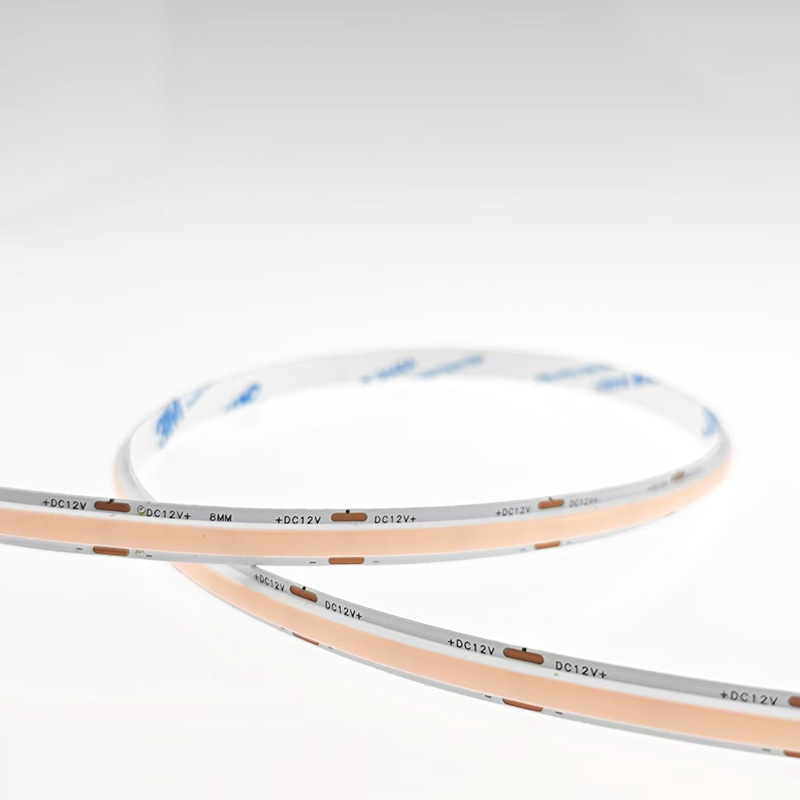
When most people think of LED strip lighting, the first images that come to mind are often under-cabinet kitchen illumination, vanity mirrors, or gaming setups bathed in RGB. However, as a supplier serving the professional market, I have watched our most innovative engineering clients transform this flexible, low-voltage technology into something far more sophisticated. From smart architecture and industrial automation to biotechnology, the engineering applications of modern LED strips are redefining how buildings operate, how factories communicate, and how spaces heal.
Here are five novel engineering-grade applications for LED strips that are reshaping industries in 2026.
1. Dynamic Visual Factories: Industrial Communication Through Color
On today's automated shop floors, audible alarms are often lost in ambient noise, and printed signs are static and easily ignored. Engineers are now embedding programmable multi-color LED strips into assembly lines to create a "visual factory." Using modular signalling systems, these strips communicate process statuses in real time—turning green when a station is ready, yellow during a machine warm-up, and flashing red for an immediate safety lockout. In pick-to-light logistics applications, an LED strip can "walk" a worker along a shelf by illuminating each pick position in sequence, reducing error rates by up to 50% while slashing training time. For gateways and intersection points, color-changing strips indicate safe passing, while a switch to red blocks entry as heavy machinery prepares to move. The result is an intuitive, low-cost safety infrastructure that demands no earplugs or reading glasses—only eyes.
2. Bio-Adaptable Human-Centric Interiors
The science of circadian health has moved decisively from research labs to building codes, and LED strips are the ideal delivery mechanism. Unlike point-source downlights, continuous strip lighting can trace architectural lines to create uniform ambient fields that mimic daylight patterns without harsh shadows or glare. New-generation tunable white strips produce smooth correlated color temperature transitions from warm 2700K at sunrise to cool 6500K at midday, then back down in the evening. By embedding these strips into ceiling coves, under desks, or along corridor handrails, lighting designers can deliver therapeutic illumination that supports melatonin regulation, alertness, and visual comfort without requiring users to stare directly into fixtures. For senior living facilities and 24/7 control centers, this is not ambiance—it is occupant health infrastructure.
3. Solar-Powered Off-Grid Linear Infrastructure
Remote construction sites, rural pathway networks, and disaster-relief shelters face a perennial challenge: how to deliver reliable illumination without expensive trenching and grid connections. Because most LED strip systems operate on low-voltage DC (typically 12V or 24V), they pair seamlessly with photovoltaic panels, charge controllers, and battery banks. A properly engineered solar-strip combination can deliver five to eight hours of nightly illumination from a modest panel array, all without a single meter of grid cable. For projects where vandalism or high installation costs rule out permanent wiring, this combination opens up lighting possibilities that were previously uneconomical—particularly when combined with motion-sensing controls that further extend battery runtime.
4. Spectrum-Tuned Vertical Farming
Controlled-environment agriculture depends entirely on artificial light, but not all photons are created equal. Plant physiologists have discovered that specific wavelength combinations—particularly deep red at 660 nm and far red at 730 nm—dramatically enhance biomass production and morphological outcomes. LED strip configurations now allow growers to layer these targeted spectra at specific growth stages using dense arrays of horticulture-grade LEDs mounted on flexible substrates. The vertical orientation of many hydroponic towers makes strips an ideal form factor: they can snake up each column, delivering uniform photosynthetic photon flux density from top to bottom without shading lower tiers. When paired with programmable controllers, a single cultivation rack can cycle through "early vegetative," "flowering," and "pre-harvest" recipes automatically—turning a shipping container into a high-yield farm.
5. Lighting as Living Infrastructure: The Algae Bioreactor
Perhaps the most conceptually radical engineering application involves using LED strips not only to illuminate but also to cultivate life. Algae photobioreactors—enclosures that grow microalgae for biofuels, nutraceuticals, or carbon capture—require precisely tuned illumination to maximize photosynthetic efficiency while avoiding photoinhibition. Smart engineers are integrating programmable LED strips directly into bioreactor panels, where varying color and intensity across the light cycle supports algae at different developmental stages. The result transforms a purely industrial process into something strangely beautiful: panels of glowing green that clean air, sequester carbon, and produce biomass simultaneously. For buildings pursuing LEED or net-zero certifications, a bioreactor facade powered by embedded strips turns the lighting budget into an environmental asset.
Conclusion
The LED strip has grown up. What once served as cheap accent lighting is now a platform for engineered outcomes—from industrial safety and human biology to agriculture and carbon mitigation. As a supplier, our role is to help specifiers understand that these applications require engineering-grade products: consistent color rendering (97+ CRI), stable long-run performance (no voltage drop over 20 meters), and appropriate environmental ratings. When you treat an LED strip as a component rather than a finished product, the applications multiply rapidly. The question is no longer "Where can we put light?" It is "What problems can we solve with light?"
 Hot News
2026-07-24
2026-07-24
2026-07-24
2026-07-24
2026-07-24
2026-07-24
 EN
EN