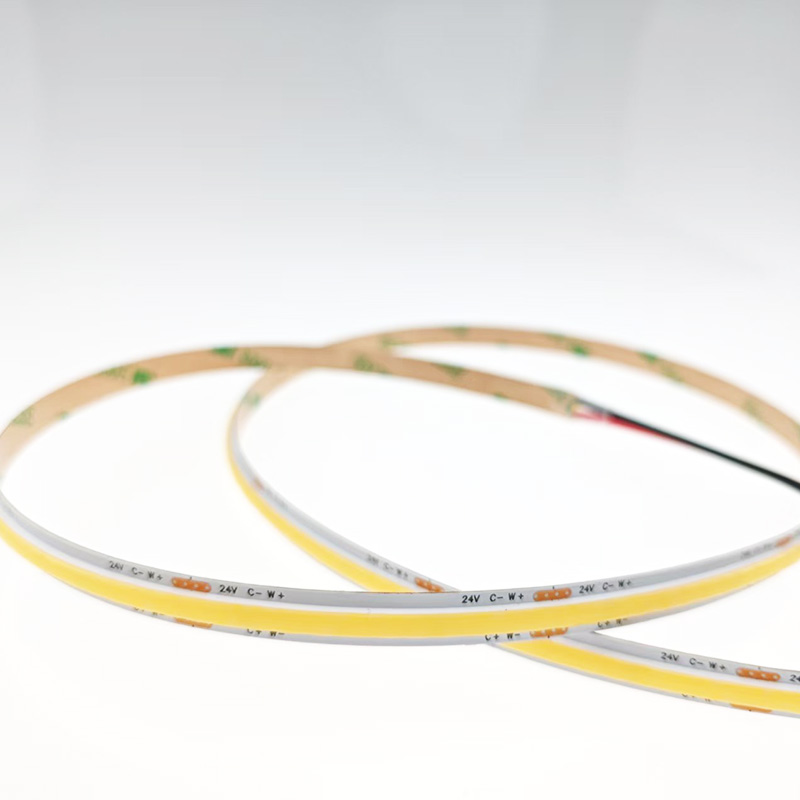
When most people think of LED strip lights, they picture cove lighting, TV backlighting, or accent illumination for retail spaces. But as a supplier serving global engineering projects, we’ve witnessed a fundamental shift. The global LED strip lights market is projected to grow from $5.12 billion in 2025 to $12.34 billion by 2032, but the real growth engine is no longer residential decor—it’s high-stakes B2B engineering applications that demand precision, compliance, and intelligence. Below are four innovative engineering applications.
Quality control in modern manufacturing relies on cameras that can detect microscopic defects at blazing speeds. Industrial LED bar light sources, designed as long-strip configurations with customizable lengths, provide the stable, uniform illumination needed for surface defect detection, edge contour analysis, and barcode recognition in automated assembly lines. Specialized models like the OPT-FCP Flat Stripe Lights use printed stripe patterns to visualize fine surface irregularities—even on highly reflective objects like polished metals or glass components—with stripe spacings of 1mm or 2mm to match specific inspection tasks. Advanced systems even employ programmable pattern LED lighting that projects striped light patterns to enhance sensitivity to specular reflection characteristics, enabling detection of defects that would be invisible under conventional lighting.
Why engineers choose it: They deliver 99.99% barcode scanning accuracy, support high-speed frequency division with up to 16 channels, and reduce inspection stations in production lines.
The COVID-19 pandemic fundamentally changed how the transportation industry thinks about surface hygiene. Today, UV-C LED modules integrated into flexible strip formats are being deployed in aircraft cabins, passenger railways, buses, and ferries to automatically disinfect high-touch surfaces between uses. These systems emit germicidal UV-C light (270–280 nm range) that destroys the molecular structure of DNA in microbial cells, achieving 99.4% sterilization rates on frequently-touched electronics and surfaces. The LUSS (LED-based Ultra-Violet exposure for Safe Surfaces) project demonstrated self-cleaning door panels that disinfect automatically after each use, eliminating the need for chemical disinfectants and the hazardous waste they generate.
Why engineers choose it: It provides continuous, chemical-free disinfection in confined spaces, reduces manual cleaning labor, and meets stringent healthcare-grade safety standards for public transit.
Traditional static exit signs have a critical flaw: when people face a real emergency, they often ignore them. Research shows that occupants are more likely to bypass conventional signage during high-stress evacuations. Enter dynamic wayfinding systems: low-mounted LED strip guides integrated along the edges of escape routes that use pulsing green arrows and red crosses to actively direct occupants away from blocked routes and toward safe exits. These systems can adjust in real-time according to changes in emergency situations - flashing red crosses indicate blocked exits, while green arrows guide people to other routes. Projects like the Südring Center in Germany have already implemented colored LED strips to mark entrances and guide pedestrians on distinct paths.
Why engineers choose it: It reduces evacuation time and dangerous bottlenecks, and transforms emergency lighting from a regulatory checkbox into an active life-safety system.
The most cutting-edge retail lighting goes far beyond product highlighting—it leverages circadian science to influence customer psychology and purchasing behavior. Dynamic shelf-edge LED systems can be programmed to shift color temperature and intensity throughout the day, mimicking natural daylight patterns to keep shoppers alert and engaged. Studies confirm that illuminated point-of-sale displays achieve significantly higher sales than those relying solely on ambient lighting, making these systems a direct ROI driver for retailers. The global shelf edge digital signage market alone is projected to reach 5.2 billion USD by 2035, growing at 7.2% CAGR.
Why engineers choose it: It increases sales conversion rates through strategic lighting psychology, supports remote content management for real-time marketing, and meets CE, RoHS global safety certifications.
A Note on Compliance
For suppliers, every engineering application comes with a non-negotiable foundation: certification. Whether you're specifiying for industrial automation, public transit, commercial buildings, or retail environments, your LED strip products must meet CE (EU), RoHS. These certifications provide facility managers and contractors with the assurance that your lighting infrastructure will perform safely and durably amid complex building systems.
The Bottom Line
We're no longer selling decorative lighting. We're engineering solutions for machine vision accuracy, public health safety, emergency compliance, and retail conversion psychology. The B2B engineering frontier for LED strip lights has arrived—and these four applications represent just the beginning.
 Hot News
2026-07-24
2026-07-24
2026-07-24
2026-07-24
2026-07-24
2026-07-24
 EN
EN