You're shopping for LED strips and see terms like "SMD 2835," "120 LEDs/m," "CRI 80+," and "lumens per watt." But what do these numbers actually mean? And how do you separate meaningful specifications from marketing fluff?
Understanding a product datasheet is the single most important skill for any LED buyer – whether you're a DIY homeowner or a commercial contractor. This guide walks you through every key specification, explains what matters, and reveals the hidden details that suppliers often gloss over.
1. LED Chip Type: SMD Numbers Decoded
You'll often see SMD followed by a four‑digit number – e.g., SMD 2835, SMD 3528, or SMD 5050.
· The first two digits = length in millimetres (0.1mm scale)
· The last two digits = width in millimetres
Examples:
· 2835 = 2.8mm × 3.5mm – slim, energy‑efficient, common for general lighting
· 5050 = 5.0mm × 5.0mm – larger, brighter, often used for RGB strips
· 3528 = 3.5mm × 2.8mm – older design, lower output
What to look for: For most residential applications, 2835 or 3014 are excellent choices for efficiency. 5050 is better for colour‑changing strips.
2. LED Density (LEDs/m or LEDs/ft)
This indicates how many individual LED chips are packed into one metre of strip. Common densities:
· 30 LEDs/m – budget, visible dots, low brightness
· 60 LEDs/m – standard, decent for hidden applications
· 120 LEDs/m – high density, smoother light, good for visible installations
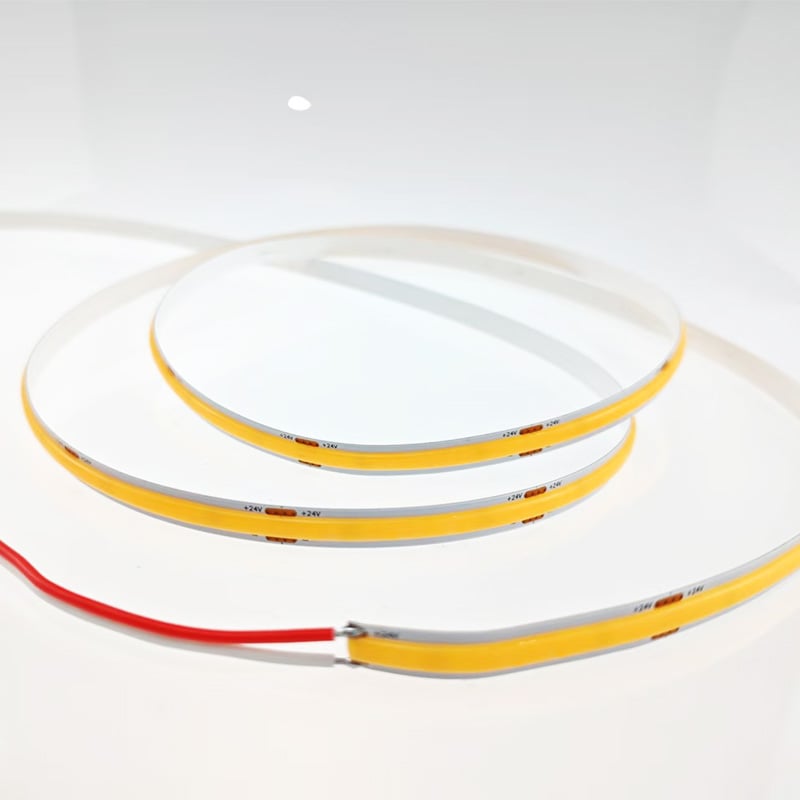
· 240+ LEDs/m – ultra‑high density, nearly seamless (often COB)
Pro tip: For visible installations (cove lighting, under‑cabinet with diffuser), choose 120 LEDs/m minimum. For COB strips, density is measured differently (often 400+ chips/m) – they appear seamless regardless.
3. Wattage Per Metre (W/m)
This is the power consumption per metre at full brightness. It directly determines:
· Brightness (higher watts generally mean more light)
· Power supply sizing (total watts = W/m × length)
· Heat output (higher watts need better heat dissipation)
Typical ranges:
· 4–6W/m – low power, accent lighting
· 8–12W/m – medium power, general task lighting
· 14–20W/m – high power, commercial or outdoor use
· 20W+ – very high power, requires aluminium profiles
Warning: Some suppliers inflate wattage to appear brighter. Always cross‑check with lumens (see below).
4. Luminous Flux (Lumens)
Lumens measure actual light output – how bright the strip appears to your eyes. This is more important than wattage for comparing brightness.
· Look for lumens per metre (lm/m) or lumens per watt (lm/W) – the latter indicates efficiency.
· A good LED strip delivers 80–120 lm/W for SMD, and slightly lower for high‑CRI or COB.
Example: A 10W/m strip at 100 lm/W gives 1000 lm/m. A 12W/m strip at 80 lm/W gives 960 lm/m – the lower wattage strip is actually brighter. Always compare lumens, not just watts.
5. Colour Rendering Index (CRI)
As covered in our previous guide, CRI measures colour accuracy. Look for:
· CRI ≥ 80 – acceptable for basic use
· CRI ≥ 90 – good for homes and retail
· CRI ≥ 95 – professional grade
Check R9 too – a high overall CRI with low R9 means reds will look dull. A good datasheet will list individual R values.
6. Colour Temperature (CCT)
Measured in Kelvin (K), this tells you the colour appearance of white light.
· 2700–3000K – warm white (cosy)
· 3500–4000K – neutral white (balanced)
· 5000–6500K – cool white / daylight (energetic)
Tunable white strips allow adjustment across a range – usually 2700–6500K.
7. Voltage and Current
· 12V or 24V DC – the operating voltage. 24V is recommended for runs over 5 metres.
· Current draw – usually listed in amps per metre or total amps. Calculate: Amps = Watts ÷ Volts.
Pro tip: A 24V strip draws half the current of a 12V strip for the same wattage, allowing longer runs with less voltage drop.
8. PCB Thickness and Copper Weight
Often overlooked, but critical for performance:
· PCB thickness – typically 2oz (ounce) copper weight is better than 1oz – lower resistance, better heat dissipation, less voltage drop.
· Flexibility – thicker PCBs are stiffer; thinner ones bend more easily but are more fragile.
What to look for: Reputable suppliers specify copper weight. If it's not listed, ask – cheap strips often use thin copper that causes voltage drop.
9. Beam Angle
Most LED strips have a 120° beam angle, meaning light spreads widely. Some specialised strips have narrower angles (e.g., 60°) for directional lighting.
Note: COB strips often have a wider, more uniform beam due to the continuous phosphor layer.
10. IP Rating (Ingress Protection)
Indicates resistance to dust and moisture:
· IP20 – indoor, dry only
· IP65 – dust‑tight and waterproof (silicone coating)
· IP67 – temporary immersion protection
· IP68 – continuous immersion
Choose based on your environment – never use IP20 in kitchens or bathrooms.
11. Lifespan (L70 Rating)
Manufacturers claim "50,000 hours" – but what does that mean? L70 means the time until brightness drops to 70% of its initial value. This is the industry standard.
· 50,000 hours = ~17 years at 8 hours/day.
· Check the conditions: lifespan is rated at a specific ambient temperature (often 25°C). Higher temperatures reduce lifespan.
12. Certifications
Look for CE, UL, RoHS, and other marks – these indicate safety and regulatory compliance. See our detailed guide on certifications for more.
13. What's Missing? – Red Flags in Datasheets
Beware of suppliers who omit:
· Lumens per metre – they may be hiding poor efficiency.
· CRI value – likely low CRI (70–80).
· Copper weight – suggests thin PCB and voltage drop issues.
· Test reports – any unverified spec should be treated with caution.
Pro tip: Always request a full photometric test report from an accredited lab (e.g., SGS, TÜV). This is the only way to verify claimed specifications.
14. Quick Reference Comparison Table
Specification Budget Strip Quality Strip Premium Strip
CRI 70–80 90 95+
Lumens/Watt 80–90 lm/W 90–100 lm/W 100+ lm/W
Copper weight 1oz 2oz 2oz+
PCB thickness Thin, flimsy Standard Thick, robust
Voltage 12V only 12V/24V options 24V preferred
Lifespan (L70) 30,000h 50,000h 50,000+ h
Certifications CE only CE, RoHS CE, UL, RoHS, REACH
Test report Not available Upon request Provided with batch
Final Thoughts
A datasheet tells the real story of an LED strip – if you know how to read it. Don't be swayed by flashy marketing or low prices. Take five minutes to review the specifications, ask for test reports, and compare apples to apples.
With this knowledge, you're now equipped to make informed, confident purchasing decisions that deliver the performance and longevity your project deserves.
We provide transparent, detailed datasheets for every product – including lumens, CRI, R9 values, copper weight, and independent test reports. Browse our collection with confidence, or contact us for personalised assistance in selecting the perfect strip for your needs.
 Hot News
2026-07-24
2026-07-24
2026-07-24
2026-07-24
2026-07-24
2026-07-24
 EN
EN