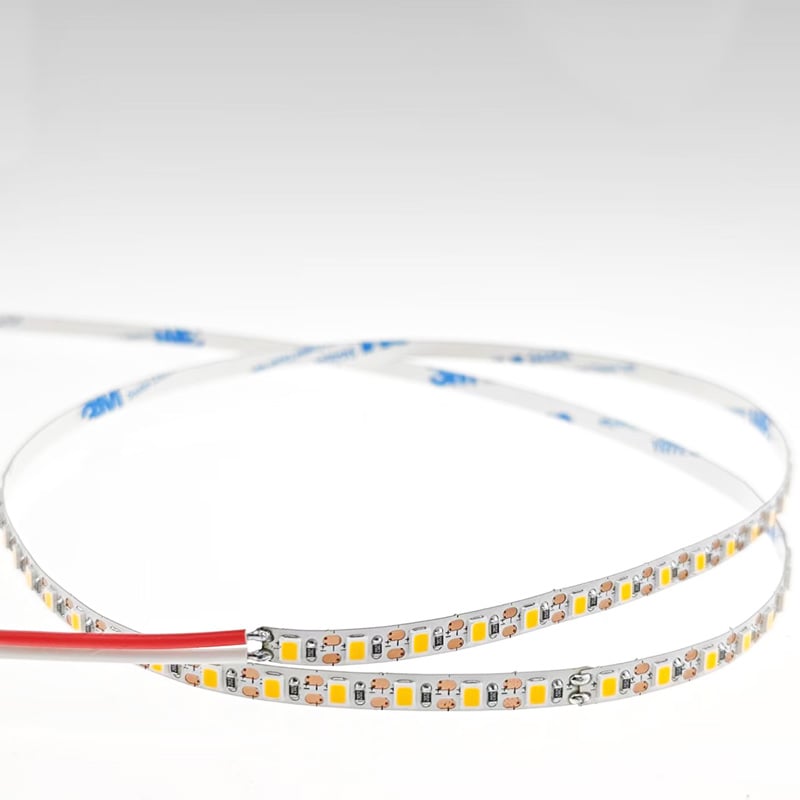
1. Stop Obsessing Over Lumens – Start Looking at Thermal Degradation
Everyone asks for high initial lumens. But here’s the question nobody asks: How bright will that strip be after 6 months inside a silicone-diffused aluminum profile?
Heat is the silent killer. Most LED strips lose 10–30% of their output within a year because of poor thermal management. A truly smart OEM partner doesn’t just offer thick copper PCBs—they show you thermal simulation data and recommend the right adhesive (thermally conductive tape vs. standard double-sided foam).
Ask for: Thermal resistance (Rth) values and real-world longevity tests at your specific operating environment (e.g., 45°C ambient). You’ll be surprised how many “high-lumen” strips fail after a short summer.
2. The Connector That Saves You Thousands in Returns
Here’s a secret: Over 60% of LED strip field failures are not from dead LEDs—they’re from broken solder joints at connector points.
When you source OEM strips, you’re probably focusing on the LEDs and drivers. But your customer’s first frustration will come from a loose connector during installation. That leads to returns, negative reviews, and eaten margins.
The angle: Work with a supplier who offers customizable connector strain relief (molded silicone boots, pre-soldered pigtails, or locking clips). It costs pennies extra but reduces your warranty claims by double-digit percentages.
3. Compliance is Not a Checkbox – It’s a Competitive Weapon
Most buyers treat CE, RoHS, or UL as something to “get at the end.” That’s reactive. The proactive approach: Use compliance as a design filter from day one.
For example, if you plan to sell into the EU market in 2026, new Ecodesign regulations (EU 2019/2020) require stricter standby power and driver efficiency. Many standard LED strips won’t meet them. By choosing an OEM partner who already designs for tomorrow’s norms, you avoid costly redesigns later.
Pro tip: Ask for a “compliance roadmap”—which certifications does the supplier plan to add in the next 12 months? A forward-looking supplier is worth far more than a cheap one.
A Quick Checklist Before You Sign That OEM Agreement
· Minimum order quantity (MOQ): Can they batch different color temps together to lower your first order?
· Customization depth: Will they change PCB width, cut length, or binning without exorbitant tooling fees?
· Transparency: Do they share actual production yield rates and incoming material inspection reports?
Final Thought: You’re Not Buying a Strip – You’re Buying Reliability
The lowest-cost supplier will cost you the most in the end. The smart OEM buyer looks beyond specs and into process: How does the supplier test for thermal decay? How do they handle connector strain? Are they three steps ahead on compliance?
Find a partner who asks you uncomfortable questions about your real application. That’s where long-term success starts.
 Hot News
2026-07-24
2026-07-24
2026-07-24
2026-07-24
2026-07-24
2026-07-24
 EN
EN