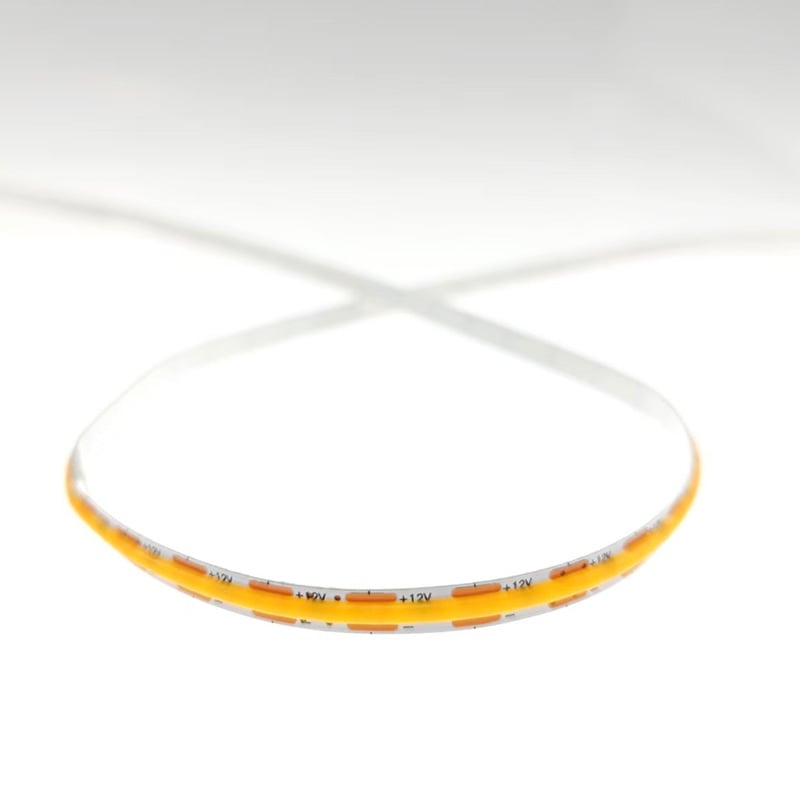
You’ve chosen the perfect colour temperature and calculated the right wattage. But there’s one specification that separates a so‑so LED strip from a truly professional one: CRI – Color Rendering Index. Many buyers overlook CRI, focusing only on brightness and Kelvin. Yet this single number determines whether your space looks vibrant and natural or dull and washed out. Here’s everything you need to know about CRI—and why it should be a top priority for your next LED strip purchase.
What Is CRI?
CRI measures how accurately a light source reproduces the colours of objects compared to natural sunlight (which has a CRI of 100). It’s rated on a scale from 0 to 100 – the higher the number, the more true‑to‑life colours appear.
For LED strips, CRI is calculated by averaging the rendering of eight standard colour samples (R1–R8). Some premium strips also specify R9 (deep red) and R12 (deep blue) values, which are critical for skin tones and vivid colours.
Key takeaway: A high‑CRI strip makes reds look red, blues look blue, and skin tones look healthy – not grey or orange.
CRI Ratings: What Do They Mean?
CRI Rating Quality Level Best For
80–85 Standard, acceptable for general lighting Warehouses, garages, utility areas
86–89 Good, decent colour rendering Corridors, stairwells, basic home lighting
90–94 High, excellent colour accuracy Living rooms, kitchens, bedrooms, offices
95–97 Premium, near‑sunlight quality Photography studios, art galleries, makeup areas, retail displays
98+ Exceptional, reference‑grade Museum conservation, surgical lighting, high‑end cinematography
Our recommendation: For any space where appearance matters – kitchens, bathrooms, living rooms, or retail – choose CRI 90+ at minimum. For critical colour work, aim for CRI 95+.
Why CRI Matters in Real Life
1. Food Looks Appetising
In a kitchen, low‑CRI lighting makes fruits and vegetables look dull. High CRI (90+) brings out the natural red of tomatoes and the green of herbs – essential for food preparation and presentation.
2. Skin Tones Look Natural
Poor CRI makes skin appear sallow or greenish. In bathrooms, dressing rooms, or salons, high CRI ensures makeup application is accurate and skin looks flattering.
3. Products Sell Themselves
Retailers know that lighting affects purchasing decisions. A garment that looks vibrant under high‑CRI strips will be bought; the same item under low CRI may be rejected. Jewellery, cosmetics, and high‑end furniture all demand CRI 95+ for true colour representation.
4. Art and Photography
Galleries and photographers rely on CRI 95+ to reveal the artist’s intended colours. Any colour shift distorts the work.
CRI vs. Colour Temperature – Don’t Confuse Them
Many buyers mix up these two concepts:
· Colour temperature (Kelvin) – Determines whether light looks warm (yellow) or cool (blue).
· CRI – Determines how accurately colours appear under that light.
You can have a warm 2700K strip with CRI 95, or a cool 5000K strip with CRI 80. The Kelvin affects mood; the CRI affects truthfulness. Both are important, but for quality, always prioritise CRI.
The Hidden R9 Factor
Most CRI ratings are based on R1–R8, which do not include deep red (R9). Many budget strips achieve CRI 80 easily but have an R9 value below 0 – meaning reds appear muted or brownish.
Why R9 matters:
· Skin tones, lips, and red fabrics rely on R9.
· A high overall CRI (e.g., 90) can still have a low R9, so always check the extended CRI report.
Pro tip: Look for strips that specify CRI 90+ with R9 50. This ensures rich, natural reds and vibrant skin tones.
How to Verify CRI Claims
Not all manufacturers are honest about CRI. Here’s how to protect yourself:
· Request the test report – A reputable supplier will provide a photometric report from an accredited lab (e.g., SGS, TÜV, Intertek). The report should list each R value.
· Compare side‑by‑side – If possible, order samples and place them next to a known high‑CRI light or natural daylight. The difference is obvious.
· Use a smartphone – While not precise, you can point your phone camera at a colour chart under different strips to see which renders colours more accurately.
Warning: If a supplier cannot provide a CRI test report, treat their claim as unverified.
CRI and LED Efficiency – The Trade‑Off
Higher CRI often comes with a slight reduction in luminous efficacy (lumens per watt). A CRI 80 strip may be 10–15% brighter than a CRI 95 strip at the same wattage.
What this means for you:
· For general ambient lighting, a CRI 80 strip might suffice if you prioritise maximum brightness.
· For task or accent lighting, the drop in efficacy is worth the colour accuracy.
Our approach: We offer high‑CRI strips that balance efficiency and colour quality – typically 90+ CRI with only a 5–10% efficacy loss, which is negligible in most applications.
CRI in Different Applications – A Quick Guide
Kitchen under‑cabinet 90+ Food prep, ingredient colour
Bathroom mirror 90+ (R9 50) Makeup, shaving, skin tones
Living room cove 90+ Warm, natural ambience
Home office 90+ Reduced eye strain, true colours
Retail clothing 95+ Accurate fabric colours
Jewellery displays 95+ Sparkle and true metal tones
Art galleries 95+ Preserve artwork integrity
Photography studios 95+ (R9 80) Critical colour matching
Garage / utility 80+ Functional, cost‑effective
Common Misconceptions
· “CRI 80 is fine for everything” – Only if you don’t care about colour quality. For living spaces, the difference is noticeable.
· “All LEDs have good CRI” – False. Many budget strips have CRI as low as 70, rendering colours poorly.
· “Higher CRI means more blue light” – Not true. CRI is independent of colour temperature. A warm 2700K strip can have CRI 95 with minimal blue content.
Final Thoughts
CRI is not a marketing gimmick – it’s a measurable indicator of light quality that directly affects how your space looks and feels. Whether you’re a homeowner, a designer, or a contractor, specifying CRI 90+ (and checking R9) ensures your LED installation delivers the visual impact you expect.
Don’t settle for dull, washed‑out colours. Invest in high‑CRI LED strips and experience the difference – true, vibrant, natural light that enhances every surface and every moment.
Explore our range of CRI 90+ and CRI 95+ LED strips, complete with full photometric test reports. We offer COB and SMD options, tunable white and fixed CCT, all backed by transparent specifications. Contact us for samples and technical data – see the quality for yourself.
 Hot News
2026-07-24
2026-07-24
2026-07-24
2026-07-24
2026-07-24
2026-07-24
 EN
EN